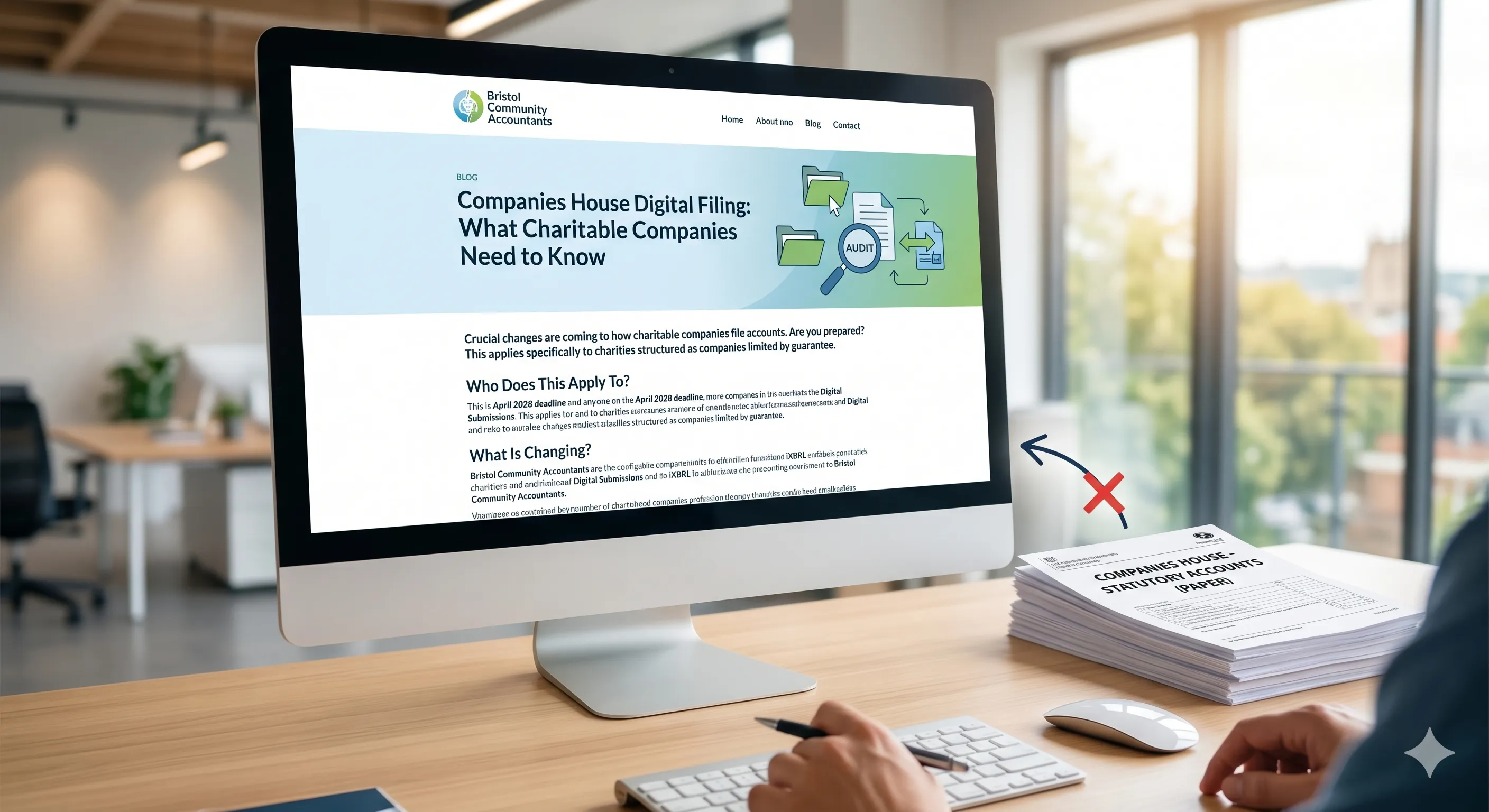
Companies House Digital Filing: What Charitable Companies Need to Know
If you run a charity, you are likely used to keeping up with regulations from the Charity Commission. However, if your organisation is also structured as a company limited by guarantee, a significant regulatory shift is coming from Companies House that will alter how your year-end accounts are submitted.
The UK government is introducing new rules under the Economic Crime and Corporate Transparency Act 2023. By April 2028, Companies House will completely close its paper-based and postal filing routes for statutory accounts, moving entirely to digital submissions.
As a firm specialising in charity accounts and independent examinations, we want to make sure our clients and the wider sector are fully prepared for this transition. Here is a breakdown of what is changing, why it matters, and how we are preparing for it at Bristol Community Accountants.
Who does this apply to?
It is vital to clarify exactly who is affected by this change:
- This directly impacts: Charitable companies (charities structured as a company limited by guarantee). Because of this dual status, you must comply with Companies House regulations alongside your Charity Commission requirements.
- This does NOT impact: Regular unincorporated charities or Charitable Incorporated Organisations (CIOs). If your charity only files accounts with the Charity Commission and does not have a company registration number with Companies House, these specific rules do not apply to you.
What is changing?
- The Old Way: Currently, we prepare and submit your charity accounts on paper via the post.
- The New Way (From April 2028): All accounts must be submitted entirely electronically using approved commercial software. The files must be submitted in a specific digital format known as iXBRL (Inline eXtensible Business Reporting Language).
How this impacts our service and your charity
This represents a significant shift for both your organisation and for us as your independent examiner. Moving away from manual, paper-based templates means we will need to completely digitise how your statutory accounts are compiled and validated.
We are already beginning to research software providers that offer charity-specific filing capabilities to ensure a smooth transition. At this early stage, we cannot yet determine the exact impact on our service provision timelines or overall costs. We will know more once we have selected the right software platform and fully evaluate the time implications of converting our current bespoke charity account templates into the new digital software format.
Next Steps
There is no immediate action required on your part. The 2028 deadline gives us plenty of time to transition carefully without disrupting your day-to-day operations.
We are tracking this closely and will keep you fully updated as we select our digital software partner and map out the transition timeline for your future accounts.
Please let us know if you have any immediate questions!