The End of “Good Intentions”: Navigating the Finance Act 2026 and Tainted Charity Donations
The landscape of charity tax compliance in the UK has just undergone its most significant shift in a decade. With the implementation of the Finance Act 2026 (which received Royal Assent on March 18, 2026, and largely came into force on April 6, 2026), the rules surrounding “Tainted Charity Donations” have been radically tightened.
For charity trustees, and donors, the message from HMRC is now unequivocal: intent no longer protects you; only outcomes matter.
The Context: Why the Shift?
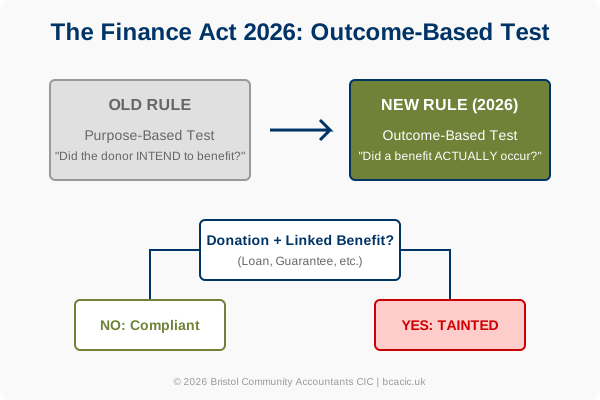
Historically, the rules around tainted donations were governed by a “main purpose” test. Under this old framework, HMRC would only penalise a donation if they could successfully prove that the donor’s primary intent was to receive a tax advantage in exchange for their charitable gift. This subjective test proved difficult for HMRC to enforce, as “intent” can be easily obscured by a seemingly clean paper trail.
HMRC found that complex financial structures were being used by some high-net-worth donors to extract value back from charities—often through loans or investments—while still claiming Gift Aid and other tax reliefs. The Finance Act 2026 was designed explicitly to close these loopholes and bring absolute transparency to charity finances.
The Objective Test: From Intent to Outcome
The most fundamental change introduced by the Finance Act 2026 is the replacement of the subjective “intent” test with an objective outcome test.
It simply doesn’t matter if you meant well or if your intentions were purely philanthropic. If a donation is linked to an arrangement that results in a benefit to the donor (or a person connected to the donor), that donation is highly likely to be classified as “tainted.”
This means that compliance is no longer about proving your good intentions; it is about examining the hard data, the flow of funds, and the clear boundaries between a donor’s charitable giving and their personal or business interests.
A Broader Net: “Financial Assistance”
Another critical element of the new legislation is the lowering of the threshold for what constitutes a problematic benefit. Previously, the law looked for a “financial advantage.” The Finance Act 2026 now looks for “financial assistance.”
This is a much broader and more encompassing term. It means that HMRC can now treat a donation as tainted if any form of financial assistance is provided to the donor as a result of the donation arrangements. This includes:
- Loans: Even if a loan from the charity to the donor (or their business) is made at strict market rates and commercial terms, it can now trigger the tainted donation rules. The “arm’s length” defense is no longer a safe harbour if financial assistance is being provided.
- Guarantees: A charity providing guarantees for the personal or business debts of a donor.
- Investments: Indirect investments made by the charity that ultimately benefit the donor’s business interests.
Retrospective Risks and Connected Donations
One of the more complex and potentially hazardous aspects of the new rules is the retrospective element. While the new rules generally apply to donations made on or after April 6, 2026, they can reach back to older donations.
If older donations (made before April 2026) are linked to “associated donations” or new financial arrangements made after the start date, those older donations can be caught under the new rules. Donors and charities must look at the entire history of their financial relationship, not just isolated transactions.
Legacies Under the Microscope
For the first time, gifts made in wills (legacies) are explicitly included in the definition of “attributable income” under these stricter rules.
Charities must ensure that legacy funds are used strictly and exclusively for charitable purposes. Any use of these funds that provides “assistance” back to the estate, its executors, or its beneficiaries could lead to retrospective tax charges and the loss of tax exemptions.
Enhanced Scrutiny of Charitable Investments
The Finance Act 2026 hasn’t just tightened donation rules; it has also unified the anti-avoidance conditions for charitable investments. All 12 categories of approved charitable investments are now subject to a single, overriding condition: the investment must be genuinely for the benefit of the charity and not a vehicle for tax avoidance. Alongside this, HMRC has been granted increased powers to sanction trustees and managers who persistently fail in their tax obligations.
What Should You Do Now? A Practical Action Plan
The Finance Act 2026 signals a new era of absolute transparency in charity finance. To protect your organisation, we recommend taking the following steps immediately:
Audit Your Donation Agreements: Carefully review all large-scale donations and related financial arrangements. Ensure that donations are completely decoupled from any other financial, business, or investment dealings the donor may have with the charity.
Update Trustee Oversight and Training: Trustees must be trained to recognise the signs of “financial assistance” that go beyond simple cash benefits. Ignorance of the new outcome-based test is not a defense.
Review Legacy and Investment Policies: Ensure your charity’s policies on accepting and utilising legacies, as well as its investment strategies, are fully compliant with the 2026 Act.
Monitor HMRC Guidance: We are still awaiting further detailed guidance from HMRC on the exact definition of “financial assistance” in complex investment scenarios. Keep a close eye on updates.
Managing the Risks of Non-Compliance
Navigating these new, stricter rules can be incredibly complex, and the stakes for getting it wrong have never been higher. Donors who use charities as part of complex financial structures are now at high risk of losing all tax relief and facing significant penalties, and trustees face increased personal scrutiny.