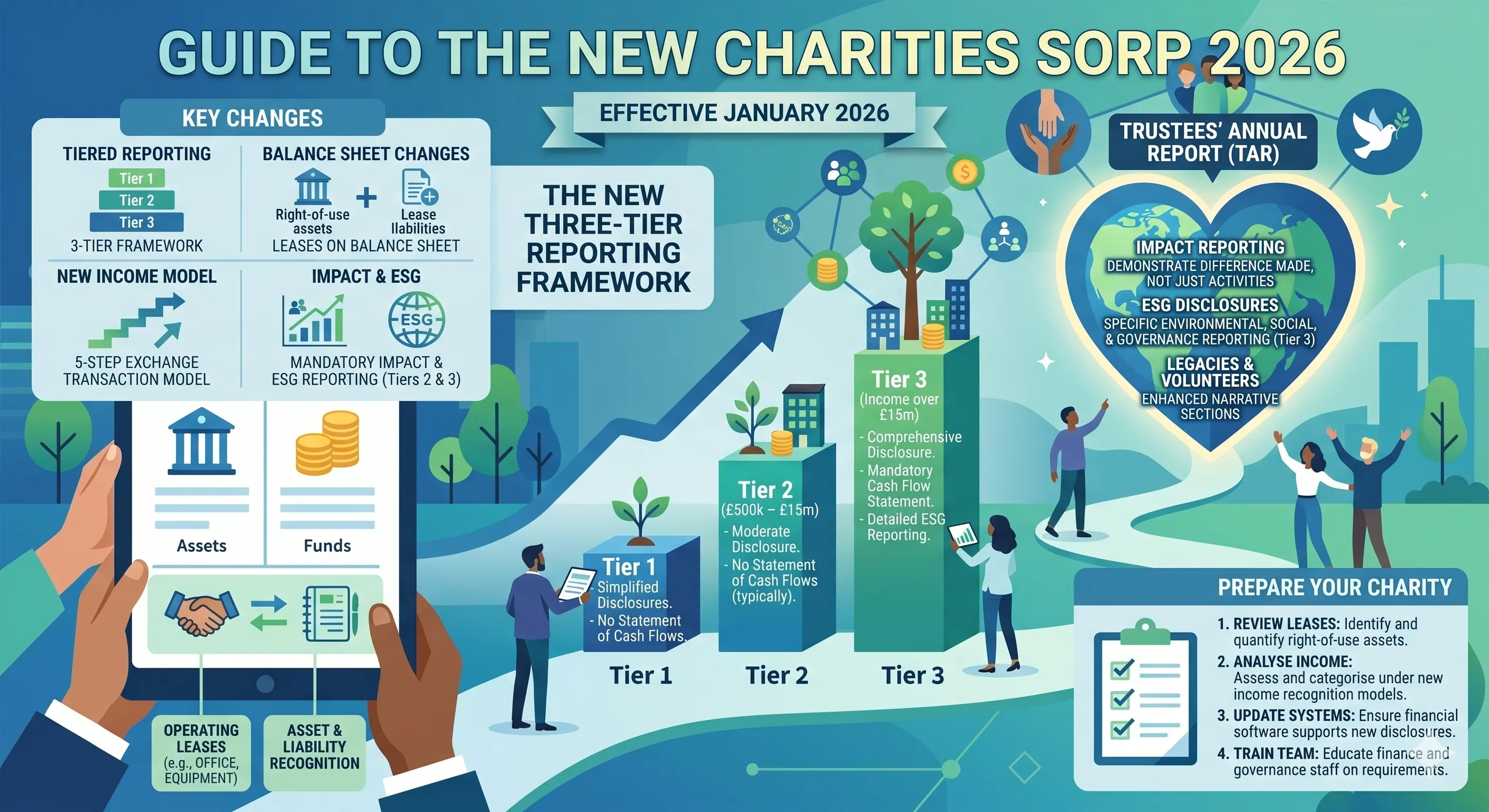
Guide to the New Charities SORP (Effective January 2026)
This guide provides a concise overview of the significant changes introduced by the new Charities SORP 2026, which becomes mandatory for accounting periods beginning on or after 1 January 2026. These updates align with the FRC’s revised FRS 102 standard, bringing the most substantial reforms to charity financial reporting in a decade.
Key Information at a Glance
- Effective Date: Periods starting on or after 1 January 2026.
- New Tiered Reporting: A three-tier structure based on income simplifies reporting.
- Major Accounting Shifts: Balance sheet recognition of operating leases, a new income recognition model, and simplified social investments.
- Enhanced Reporting: Mandatory impact reporting and ESG disclosures for larger charities.
- Threshold Updates: Changes to audit, accruals accounts, and independent examination thresholds.
Understanding the New Three-Tier Reporting Framework
The SORP 2026 introduces a tiered approach to reporting, designed to be more proportionate to a charity’s size and complexity:
Tier 1 (Income up to £500,000): * Simplified disclosures. * No requirement for a Statement of Cash Flows.
Tier 2 (Income £500,000 – £15 million): * Moderate disclosure requirements. * Generally no Statement of Cash Flows required (unless mandated by FRS 102 for non-small entities).
Tier 3 (Income over £15 million): * Comprehensive disclosures. * Mandatory Statement of Cash Flows. * Detailed ESG (Environmental, Social, and Governance) reporting.
Significant Accounting Changes to Note
The SORP 2026 brings notable changes to how charities account for certain transactions:
1. Lease Accounting
A significant shift requires most operating leases (e.g., for office space or equipment) to be recognised on the balance sheet. This involves recording them as “right-of-use” assets, with corresponding lease liabilities.
2. Income Recognition
A new five-step model is introduced for “exchange transactions” – where a charity provides goods or services in return for a fee (e.g., care contracts, tuition fees). Non-exchange transactions (donations, grants) follow separate rules, though guidance is clarified.
3. Social Investments
The SORP simplifies social investments by removing the distinction between “programme-related” and “mixed-motive” investments. They are now treated as a single category.
Trustees’ Annual Report (TAR) & ESG
The Trustees’ Annual Report now includes more detailed narrative requirements:
- Impact Reporting (Mandatory for all): Charities must report on the impact of their work, moving beyond activity lists to demonstrate the difference made.
- ESG Disclosures: Larger charities (Tier 3) must provide specific disclosures on Environmental, Social, and Governance matters.
- Legacies & Volunteers: Enhanced narrative sections are required concerning the recognition of legacies and the utilization of volunteer contributions.
Important Threshold Changes (England & Wales - Expected Oct 2026)
Alongside the SORP, statutory thresholds are increasing, impacting audit and examination requirements:
- Audit Threshold:
- Income limit increases from £1 million to £1.5 million.
- Asset limit increases from £3.26 million to £5 million.
- Accruals Accounts: The income threshold for mandatory accruals accounts (and thus SORP compliance) doubles from £250,000 to £500,000. Charities below this can continue using simpler Receipts and Payments accounts.
- Independent Examination: The income threshold for requiring an external examiner rises from £25,000 to £40,000.
What Your Charity Needs to Do
Prepare for the new SORP by taking these steps:
- Review Leases: Identify all current operating leases and assess their potential impact on your balance sheet. Analyse Income Streams: Determine which of your contracts fall under the new five-step “exchange” transaction model.
- Update Systems: Ensure your accounting software and internal reporting processes can accommodate the new tiered disclosures, impact reporting, and other changes.
- Train Your Team: Familiarise your finance and governance teams with the new requirements and the effective dates.
This guide provides a summary of key changes. For detailed guidance, consult the full Charities SORP 2026 and FRS 102, and seek professional advice.